
Blog > What to Ask Before Hiring a Paid Ads Agency
10 Questions to Ask Before Handing Over Your Paid Media Budget to an Agency

By Cullen E

Handing your ad budget to an agency is not a small decision.
That budget is cash. And cash is the lifeblood of your business. For most founders, this is also the first time a meaningful chunk of the business is being run by someone outside of it.
If you've built everything in-house up to this point, that loss of control can feel uncomfortable - and it should. It's your money on the line.
But there's another side to this.
A good agency relationship doesn't just keep the lights on - it drives growth. It gives you, as the founder, time back to focus on the parts of the business only you can do. You stop being the bottleneck for paid media and start scaling.
The difference between those two outcomes - wasted budget or real growth - usually comes down to one thing: getting the hire right the first time.
That means asking the right questions, and knowing what a good answer actually sounds like - which we'll cover in this article.
Key Takeaways:
-
The best time to vet an agency is before you're on the call - check their case studies, reviews and transparency first
-
A good agency gives honest, specific answers tied to your business; a bad one gives guarantees, vague reassurance and pushy contracts
-
You should always own your ad account, pixel and data, and you should never be locked into a 12-month contract on your first agency partnership
Am I Ready for a Paid Ads Agency?
Before you spend time vetting paid ads agencies, sense check whether your business is even in the right place to hire one.
An agency amplifies what's already working. It doesn't create demand from nothing. If the foundations aren't there, no agency - however good - is going to make paid ads profitable for you.
You're ready if:
-
You're seeing organic growth: Word-of-mouth, SEO, organic social and other channels are working and bringing in customers
-
You have product-market fit: Customers buy, come back, and genuinely like your product
-
You have a website that converts cold traffic: Not just warm visitors who already know you - strangers
-
You have at least £3,000-£5,000 a month to put towards ad spend
These points matter because an agency works with what you give it.
If your organic channels are dead, your product isn't landing, or your site doesn't convert, paid traffic will expose those problems fast - and expensively. Paid ads pour fuel on the fire. You need a fire first.
If you're not there yet, fix the foundations before you hire. If you are, read on.
10 Questions to Ask Before Hiring an Agency
Most founders walk into agency calls and let the agency run the conversation. That's backwards.
You're the one handing over the budget. You set the agenda. The ten questions below are designed to do exactly that - cut through the sales pitch and show you who you're actually dealing with.
For each one, we've laid out what a good answer sounds like. Because the question alone isn't enough - you need to know how to read the response.
1. Who Will Actually be Running My Account Day-to-Day?
The person on the sales call is rarely the person managing your account.
That's not automatically a problem - but you need to know. Plenty of founders sign with an agency on the strength of one impressive call, then find their account is handed to someone they've never spoken to.
So ask directly. Find out what system the agency has for managing accounts, who specifically will be working on yours, and what experience that person has with brands like yours.
You want to know the day-to-day operator is competent and has handled businesses at your stage and in your space - not just that the founder or sales lead is sharp.
2. What Does the First 90 Days Look Like?
This question separates agencies with a real onboarding process from the ones that send an invoice and start "getting to work."
A good answer is a clear, systematic breakdown of how onboarding runs - what gets worked on in the first 90 days, and why. There should be a logic to it: account setup and tracking, then research and strategy, then initial campaigns and testing.
What you don't want to hear is guarantees of incredible results inside 90 days. Nobody can promise that, and an agency that does is telling you how they sell, not how they work.
3. How Do You Approach Creative Strategy?

Ask whether they produce creative, direct it, or expect you to supply it.
There's no single right answer here - some agencies produce assets in-house, others direct and brief while you handle production. What matters is that they have a system, and that you both know who's responsible for what.
Here's why this question is on the list: in 2026, creative is the bottleneck.
It's the single biggest lever in paid social, and founders get blindsided by it constantly. They sign with an agency assuming creative is handled, then discover three weeks in that they're expected to deliver a steady stream of video and image assets themselves.
Get clarity on this before you sign, not after.
4. How Do You Measure Performance and What Metrics Will You Track?
A good answer ignores vanity metrics.
Impressions and clicks feel like progress, but they don't pay the bills. A competent agency focuses on bottom-line numbers - conversions, ROAS, CPA. That's the baseline.
The best answer goes further. It ties reporting to your actual profitability. A great agency understands the difference between engagement metrics and conversion metrics, knows where each one matters, and connects the numbers on the dashboard to the money in your bank account.
If an agency only talks about results inside the ad platform and never about your margins, it's measuring the wrong thing.
5. How Will You Report Back on Performance and Keep Us Up-To-Date with Changes?
Great agencies report in business terms, not technical jargon.
You shouldn't need a media buying glossary to understand your own reports. A good agency frames performance around the goals and KPIs you set together, and explains what's happening in language a busy founder can act on.
A good answer involves a clear plan for running tests, finding learnings, and reporting those back to you regularly - not just sending a dashboard once a month and going quiet.
It's your call how often you want reports - weekly, bi-weekly or monthly.
Every agency works differently, so find one whose rhythm matches what you need.
Also pin down catch-up calls: are they included, how often, and does that match your expectations? If you want a fortnightly call and the agency only does quarterly reviews, that's a mismatch worth knowing about now.
6. What Happens if the Account Isn't Performing After Three Months?
Not every agency partnership works out. That's OK - and a good agency will say so.
This question tests whether they can give you an honest answer or just more reassurance.
An agency that insists it never happens is either inexperienced or not being straight with you.
A good answer is upfront about the scenario: here's what we'd do, here's how we'd diagnose it, and if it's not working, you can part ways without additional charges. They don't lock you in.
They're confident enough in their work that they don't need a contract to keep you.
7. How Are Your Management Fees Structured?

Be totally clear on how, and how much, you're charged.
Most agencies use a performance-based fee, a flat fee, or a mix of both. There's no single correct model - but there is a correct level of transparency.
(For a full breakdown of pricing models and what's included in a management fee, see our paid advertising cost guide.)
A good answer gives you clear, upfront expectations on the actual cost - based on your specific account and ad spend, not a vague range. As a guide, management fees should typically land between 10-20% of your total monthly ad spend.
If an agency is cagey about fees or can't give you a straight number, treat that as information.
8. Who Owns the Ad Account, the Pixel, and Data if we Part Ways?
The answer here is simple, and you should not accept anything else: you do.
The brand owns the ad account, the pixel, and all the data. If you part ways, all of it stays with you.
Some agencies set up campaigns inside their own accounts and keep ownership - which means when you leave, you leave with nothing. No historical data, no pixel learnings, nothing to hand to the next agency.
Ask the question directly. If the answer is anything other than "you own it all", walk away.
9. What am I Committed To? (What Does the Contract Length and Exit Look Like)
Be wary of agencies that push a 12-month contract straight away.
As your first move into paid media - or your first agency partnership - you need the freedom to step away if it isn't working. Long lock-ins protect the agency, not you. Look after your cash and only sign contracts that work in your favour first.
Get clarity on both the commitment and the exit. How long is the term? What's the notice period? What happens, practically, when you want to leave?
A good answer means the agency will offer reasonable terms and a clean exit, because it expects to keep you on results, not on paperwork.
10. Here's Our Situation and the Main Challenge We're Facing - How Would You Approach It?
Every business has a specific challenge or goal - a plateau, a thin margin, a competitive niche, a seasonal swing.
This question tests whether the agency actually understands yours. Lay out your real situation and ask how they'd approach it.
A good answer gives you a top-level strategy, or references a previous client who faced something similar and walks you through how they navigated it. What you're listening for is genuine engagement with your problem.
If the agency just restates its standard service offering instead of responding to what you've described, it isn't thinking about your business - it's thinking about its pitch.
Questions to Ask Before Hiring a Paid Ads Agency: Cheat Sheet
Ready to Grow Your Brand with a Paid Ads Agency?
Use the contact form below or contact me on 07837211760 for a free consultation on paid ads for your online brand.

Cullen Evans
15 Minutes
No Commitment
Free Consultation & Advice
Phone, Video Call or Email
"Cullen has helped to grow our online sales by 40% month on month over the last 6 months."
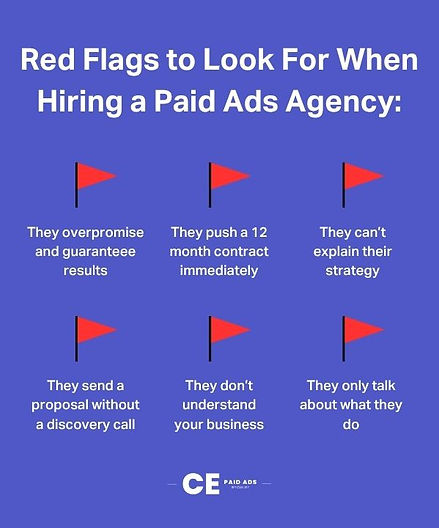
Red Flags to Look Out For When Hiring a Paid Ads Agency
While you're working through those questions, watch for any of these agency red flags. Any one of them should give you pause.
-
They guarantee results: Nobody can guarantee paid ads performance. An agency that does is selling, not advising
-
They push a 12-month contract immediately: This is a pressure tactic. It tells you they're focused on closing you, not aligning with you
-
They can't explain their strategy in plain English: Vague answers, jargon, and skirting around how they'll actually work are a sign there's not much underneath
-
They send a proposal without a proper discovery call: A proposal written before they understand your business is a template
-
They don't understand your specific business: If they haven't engaged with your situation, they're not the right fit
-
They only talk about what they do, not how they can help you: Good agencies make it about your business. Bad ones make it about themselves
What to Check Before You Jump on a Discovery Call
You can filter out a lot of agencies before you ever speak to one.
Even with the right questions in hand, calls take time. Do this groundwork first and only spend your time on agencies genuinely suited to help you:
-
Case studies relevant to your business: Look for work in your niche, your model, or a comparable situation - not just a wall of impressive numbers from unrelated brands
-
Reviews and testimonials that reflect how they work: Results matter, but so does what it's actually like to work with them. Look for comments on communication, responsiveness and reliability
-
A service offering that covers all bases: Strategy, management, reporting, paid search, paid social, and creative strategy. Gaps here become your problem later
-
Experience in your industry or business model: An agency that already understands your space gets up to speed faster
-
Transparency on their website: Check the FAQs for clear answers on pricing, process, strategy and reporting. Reputable agencies don't hide this - they're confident enough in their service to put it out in the open
Going into the Hiring Process With the Right Expectations
The questions and checks above are about vetting the agency. This part is about vetting yourself.
Before you get on a call, get your own expectations straight - so both sides can have a productive conversation that actually moves you towards your goals.
An Agency's Job is Not to Validate Your Business Model
This goes back to readiness: you should already be in a position where the business is ready for paid ads.
The agency amplifies the best parts of what you've built - it doesn't prove the concept for you.
Your KPIs Need to be Rooted in Reality
ROAS and CPA targets should reflect the actual economics of your business, not a number that sounds good. Great agencies do great work, but they can't produce miracles.
Set targets that are achievable yet ambitious - that way you can genuinely judge whether the agency is performing. A target that was never realistic just guarantees a partnership that "fails" on paper, regardless of how good the work is.
Understand What the Agency Needs From You
You have to supply context, brand information, creative assets, and timely feedback. An agency starved of input produces generic work.
The best partnerships are two-way - the agency brings the expertise, you bring the knowledge of your business that nobody else has.
Summary
Handing your paid media budget to an agency is one of the bigger bets you'll make as a founder - and the outcome is largely decided before you ever sign.
Get the hire right and you get growth, plus time back to run the rest of the business.
Get it wrong and you've handed your cash to someone who burns it.
The way to get it right is to start vetting properly. Check the agency's case studies, reviews and transparency before the call. Then use the ten questions to cut past the pitch - and, just as importantly, know what a good answer sounds like.
Honest, specific responses tied to your business are green lights.
Guarantees, jargon and pushy contracts are red flags. Make sure you own your account, pixel and data, and never lock yourself into a long contract on a first partnership.
Finally, hold up your end. Be ready before you hire, set realistic targets, and feed the agency the input it needs. Do all of that and you're not gambling with your budget - you're making an informed hire.
Frequently Asked Questions

Cullen Evans
I've managed paid ads campaigns across Google, Meta and TikTok Ads for 10+ years and share my expertise through online content, guides, articles and videos.